
Fireplace installation questions answered plainly
Irish pricing, Part J hearth rules, RGII gas certification, stone thermal expansion, back-boiler removals and VAT in one place.
Free, no obligation. One local installer prices it, not five.
- €1,800–€4,800typical complete suite fitted
- €550–€1,100fit-only surround & hearth labour
- RGII & I.S. 813legal requirement on gas fires
- 125 / 250 mmPart J constructional hearth depth
Price my fireplace
Four taps reveal an Irish fireplace guide before any phone number is requested. One local installer rings you, not five.
A marble or limestone fireplace surround into a Class 1 brick chimney, supplied and fitted: €2,100 to €4,400.
How these fireplace figures are worked out
Supply-and-fit bands reflect typical Irish pricing for marble, Portuguese limestone, cast-iron, gas or solid-fuel suites fitted into a sound opening, including bedding the hearth and sealing slips. Gas options allow for an RGII installer, soundness testing and a Declaration of Conformance. Fit-only figures cover skilled installation labour, hearth slabbing and making good when you supply your own mantel and hearth. Old back-boiler plumbing removal, structural RSJ beams, chimney relining and bespoke plastering depend on what lies behind the plaster and are priced once inspected.
Every fireplace question answered
How much does it cost to install a complete fireplace in Ireland?
A complete fireplace surround, hearth and fire supplied and fitted in Ireland typically costs €1,800 to €4,800. Portuguese limestone and marble suites start near €2,100, RGII gas fire packages run €2,400 to €4,600 into an existing chimney or €2,900 to €5,800 with an outside-wall balanced flue, and fit-only surround labour runs €550 to €1,100.
How much is fit-only labour if I buy my own surround and hearth?
Skilled fit-only labour to level and bed a slabbed hearth, pin a marble, limestone or cast-iron surround and seal slips runs €550 to €1,100 into a sound opening.
What hearth thickness and projection does Part J mandate?
Under Irish Building Regulations Technical Guidance Document J, a solid-fuel fireplace requires a non-combustible constructional hearth at least 125 mm thick (250 mm directly over timber without a 50 mm air gap), projecting at least 300 mm in front of an open fire and 150 mm to each side, plus a certified I.S. EN 50291 carbon monoxide alarm.
Do I legally need an RGII installer to fit or disconnect a gas fire?
Every natural gas or LPG fire installed, altered or disconnected in Ireland must be handled by a Registered Gas Installer (RGI) working to I.S. 813. On handover you must receive the signed, numbered Declaration of Conformance confirming gas soundness, operating pressure and flue spillage tests.
What is the difference between a slabbed hearth and a one-piece hearth?
A one-piece marble or granite hearth expands unevenly under burning coal or timber and frequently snaps right down the middle. A slabbed hearth is cut into sections, reinforced underneath with concrete and mesh, and absorbs heat movement cleanly.
Can Portuguese limestone be used with a real solid-fuel open fire?
Yes, provided the hearth and slips are properly slabbed for heat expansion and the porous limestone is sealed with a breathable stone sealer so soot wipes away cleanly.
Why does engineered quartz not suit solid-fuel open fires?
Engineered quartz contains polymer resins that blister, yellow and crack under sustained solid-fuel temperatures. Use natural marble, granite, limestone or slate for solid fuel, and keep quartz for gas or electric appliances.
How do I tell if my house has a Class 1 chimney or a shallow precast flue?
Houses built before 1970 and most rural builds have brick or concrete Class 1 chimneys with an external roof stack and clay pot. Many 1970s to 2000s estate homes have shallow precast concrete flues vented via a ridge terminal tile on the roof.
Is a carbon monoxide alarm mandatory when fitting a fireplace?
Yes. Under S.I. No. 133 of 2014 (Part J), any new or replacement open-flued or flueless combustion fireplace requires an audible I.S. EN 50291 CO alarm in the room and coverage within 5 m of bedrooms.
How much does removing an old back-boiler fireplace cost?
Draining old gravity pipes, disconnecting the cast boiler safely, clearing rubble and making good the opening runs €650 to €1,400.
Do I need a structural engineer to remove a chimney breast?
Yes, whenever any portion of the chimney breast or masonry stack remains above the floor you are removing. An engineer sizes the steel RSJ beam or lintel support (typically €300 to €650).
What VAT rate applies to fireplace supply and installation?
Buying a surround, hearth or gas fire supply-only carries 23% VAT. Permanently fitted fireplace installations qualify for 13.5% VAT under Revenue's two-thirds rule only when the net material cost stays at or under two-thirds of the VAT-exclusive bill.
How long does fitting a new fireplace take?
Stock marble, limestone or cast-iron surrounds are normally fitted within 1 to 3 weeks, taking 1 day on site. Gas suites and chimney breast alterations run 2 to 5 weeks, while bespoke carved stone takes 4 to 8 weeks.
Who receives my contact details after I use the planner?
Your fireplace outline and mobile number go straight to a single fireplace installer in your county, and nobody else. They arrange a chimney and wall check and issue a written quote.
Every Irish fireplace guide on this site
Surrounds & fires
Regs, flues & prep
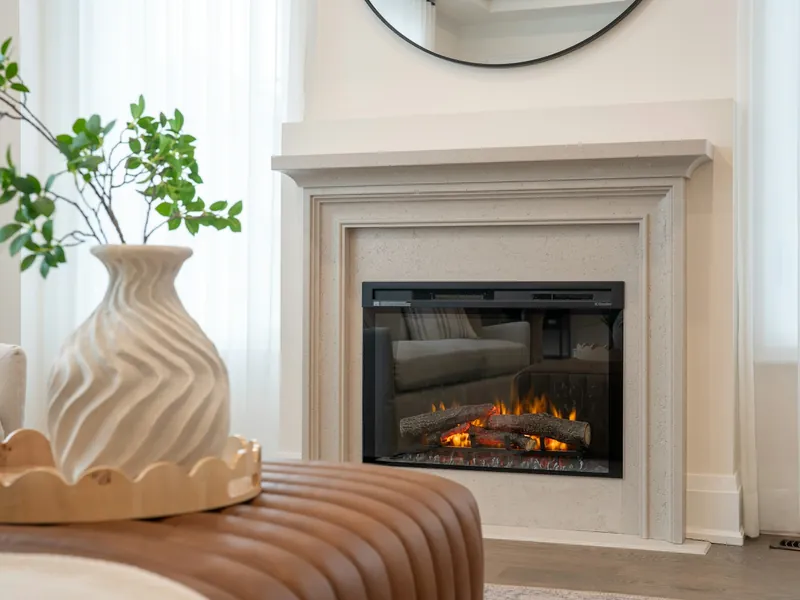
Check your fireplace price before anyone calls
Choose the surround style, chimney situation and supply or fit-only scope. One written quote comes back from a single fireplace installer in your county.